The Art of Subtraction: Samuel Beckett and the Waiting Game


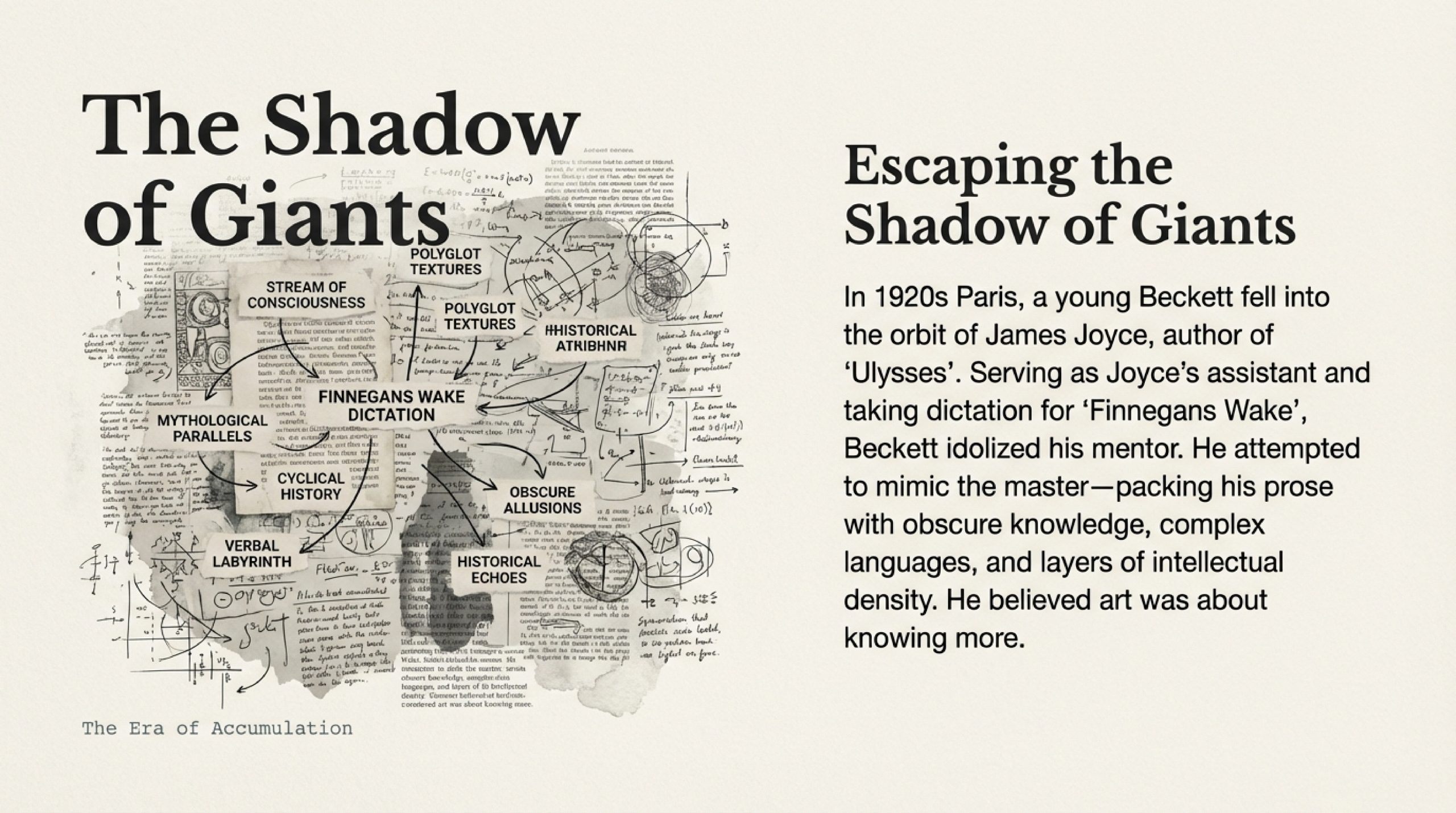
In his twenties, Beckett moved to Paris and fell into the orbit of James Joyce, the author of Ulysses. Beckett idolized Joyce, working as his assistant and even taking dictation for Finnegans Wake. For years, Beckett tried to write like his mentor, packing his prose with obscure knowledge and complex language.
However, in 1945, while visiting his mother’s room in Dublin, Beckett had a revelation. He realized that Joyce had gone as far as one could go in the direction of knowing everything and adding layers. Beckett decided his own path must be the opposite: the art of ignorance and impotence. He would write about “poverty, failure, exile, and loss.” This “art of subtraction” became the philosophical bedrock of Waiting for Godot—a play where the setting is empty, the characters possess nothing, and the plot is that nothing happens.

The true emotional landscape of Waiting for Godot was forged during World War II. When the Nazis occupied France, Beckett—who was an Irish citizen and could have remained neutral—joined the French Resistance. He worked as a courier, translating and smuggling intelligence reports. It was dangerous work; his cell was eventually betrayed, and many of his friends were sent to concentration camps.
Barely escaping the Gestapo, Beckett and his partner Suzanne Dechevaux-Dumesnil fled Paris. They made their way south to the village of Roussillon, in the unoccupied zone. For two years, they lived in hiding, waiting for the war to end.
It was here, in the boredom and anxiety of Roussillon, that the seeds of Godot were sown.
-
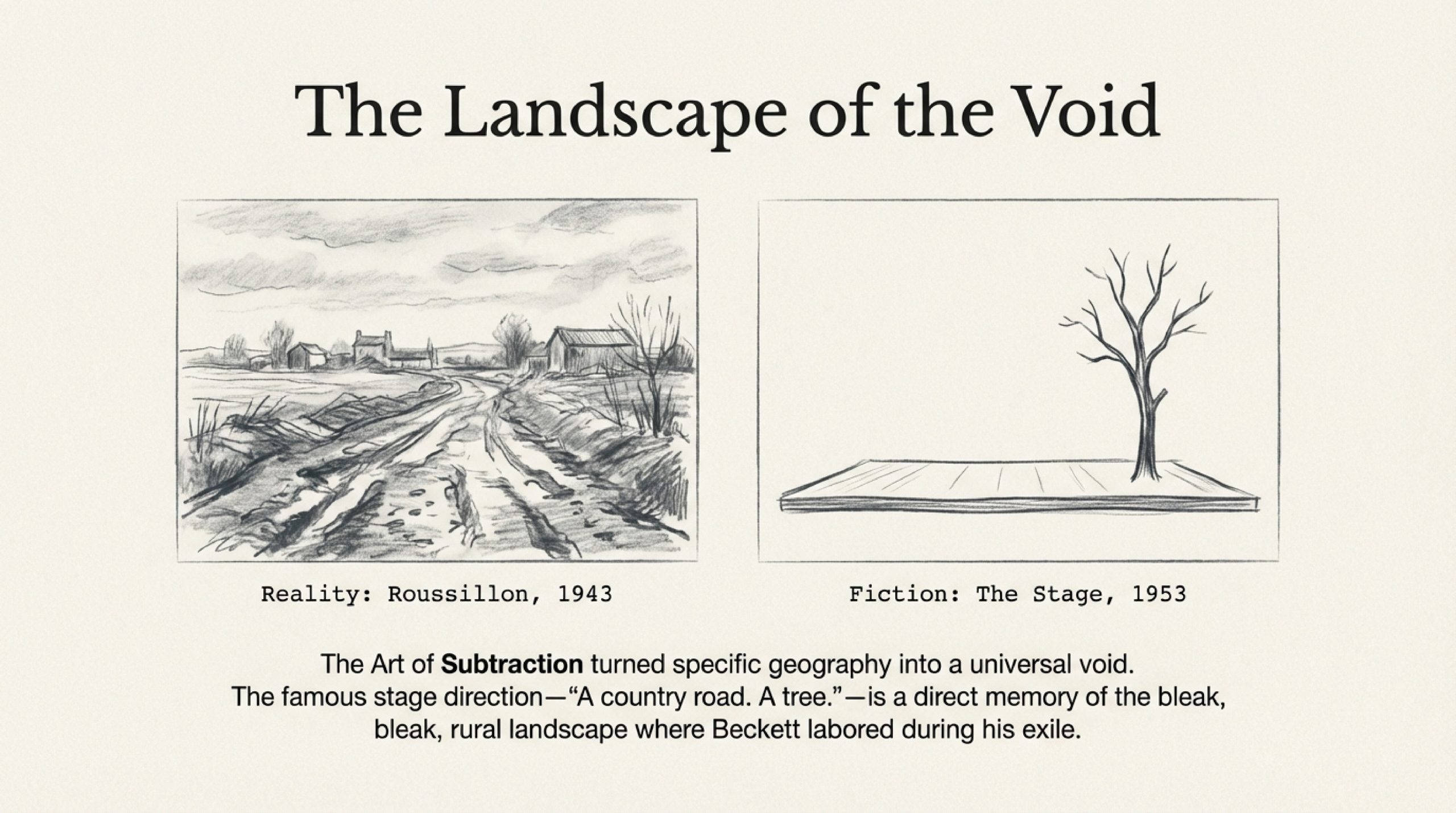
The Landscape: The play’s setting—”A country road. A tree.”—is reminiscent of the bleak, rural landscape of Roussillon where Beckett worked as a farm laborer during the day.
-
The Dynamic: The relationship between Vladimir and Estragon mirrors the codependency of refugees hiding from a threat they cannot control. Their circular conversations, desperate games to pass the time, and fear of being beaten by “them” reflect the psychological state of waiting for liberation (or capture) during the war.
-
The Boots: Beckett walked miles in ill-fitting boots during his escape from Paris, an experience immortalized in Estragon’s constant struggle with his painful boots.

Beyond the war, Beckett drew from visual art. He later revealed that the visual composition of the play—two small figures silhouetted against a vast sky—was inspired by the painting Two Men Contemplating the Moon (1819) by the German Romantic painter Caspar David Friedrich. The painting features two figures seen from behind, leaning on one another in a twilight landscape, evoking the same sense of shared isolation found in the play.
